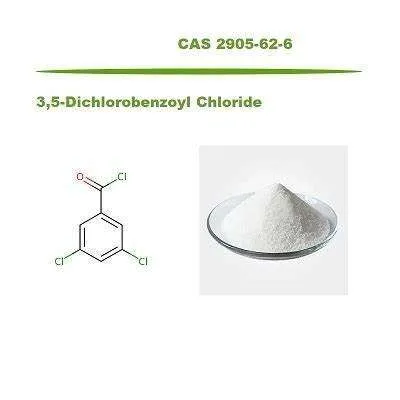
3,5-Dichlorobenzoyl chloride is an important intermediate for the production of pesticides, medicines, and dyes. In pesticide manufacturing, it can be used to prepare pesticides through a reaction with benzoic acid.
Molecular Formula: C7H3Cl3O
Molecular Weight: 209.46
Melting point |
28 °C (lit.) |
Boiling point |
135–137 °C/25 mmHg (lit.) |
Density |
135 |
Vapor pressure |
0.1 mm Hg (32 °C) |
Refractive index |
n20/D 1.582 (lit.) |
Flash point |
>230 °F |
Storage temperature |
Refrigerator (+4 °C) |
Solubility |
Soluble in benzene and toluene |
Form |
Powder to lump; clear liquid |
Color |
White or colorless to almost white or almost colorless |
Sensitive |
Moisture sensitive |
Symbol (GHS) |
|
Signal word |
Danger |
Hazard codes |
C |
Hazard note |
Corrosive |
Hazard class |
8 |
Packing group |
II |
HS Code |
29163900 |


3,5-Dichlorobenzoyl chloride is an important intermediate for pesticides, medicines, and dyes. In pesticide production, pesticides can be prepared via the reaction of benzoic acid. In pharmaceuticals, headache drugs and antidiuretic hormone drugs can be prepared. It is also an important intermediate for the synthesis of the pesticide herbicides pentoxachlor, and is widely used in the fields of pesticides, pharmaceuticals, photosensitive materials, and more.
3,5-Dichlorobenzoyl chloride is a useful intermediate for organic synthesis and other pharmaceutical processes. 3,5-Dichlorobenzoyl chloride has been used in the preparation of:
N-(1,1-dimethylpropynyl)-3,5-dichlorobenzamide (herbicide)
(3,5-dichlorophenyl)(2-(4-methoxyphenyl)-5-methylbenzofuran-3-yl)methanone
3,5-Dichlorobenzoyl chloride is an important intermediate for the synthesis of fenpropargyl, which is widely used in pesticides, pharmaceuticals, photosensitive materials, and other fields.
3,5-Dichlorobenzoyl chloride is obtained by reacting an aryl carboxylic acid with DMF. Dissolve the aryl carboxylic acid (10.0 mmol) in 50 mL DCM with drops of DMF in a 100 mL round-bottom flask. Cool the mixture to 0 °C. Add oxalyl chloride (20.0 mmol, 2.0 equivalents) dropwise to the reaction mixture. Allow the reaction mixture to react for an additional 4 hours. Concentrate the solvent under vacuum. Use the remaining residue directly.